About: This inspiring piece explores how art can help break the silence around violence against women and girls. Drawing on research and on With Art Violence Ends, a WAVE-supported microgrant project in Serbia, it shows how film, painting, collage and poetry opened spaces where young women could connect, share their experiences and take conversations about violence into their community.
By Teodora Milosavljević, 4th generation WAVE Youth Ambassador (Serbia)
There is nothing more frightening or exciting than a blank piece of paper. Frightening because you’re on your own, leaving dark tracks across that snowy plain, and exciting because no one knows your destination but yourself, and even you can’t say exactly where you’ll end up. – Robert McCammon
Can a piece of art end violence?
At first, it sounds almost too optimistic. Violence is usually addressed through laws, institutions, and their policies, not through paintbrushes, collages, or poetry. Yet, more and more research suggests that creativity has a unique power to transform the way we process emotions, relate to others, shift attitudes, break silence, and mobilise communities to act – the very preconditions that laws and institutions depend on to work.
A study published in The Arts in Psychotherapy found that just 45 minutes of creating art significantly lowers cortisol, the body’s primary stress hormone, while research in Trauma, Violence, & Abuse shows that art therapy helps people process trauma, improve emotional regulation, and recover from experiences of violence. Rather than suppressing anger, fear and/or pain, artistic expression gives those emotions somewhere to go. It helps people understand themselves before those emotions become destructive, while also creating a dialogue, within or outward.
While art can create a private space for processing difficult emotions, its impact does not end there. A study published in Women’s Studies International Forum examined visitors’ responses to an art exhibition addressing violence and found that the experience prompted personal reflections, increased awareness, and willingness to encourage others to engage and learn too. Those affected by violence, whether as children or as adults, expressed feeling less alone and also expressed a sense of empowerment after viewing the artworks. Many actively encouraged others to gain strength and to persevere.
Turning Research into Action
These findings made me wonder what could happen if art were intentionally used to create spaces where young women could process difficult experiences, connect with others, start conversations, and challenge the silence surrounding violence. Together with Marta Stanojević from the Centre for Girls in Niš, we wanted to explore this idea in practice. This became the starting point for the With Art Violence Ends project, supported by WAVE through its microgrant programme, running from April to May 2026 in Niš.
Creating Spaces for Connection
The project’s first activity, Feminism & Chill, brought together a group of strangers for a screening of the award-winning animated film Granny’s Sexual Life followed by conversations about violence, patriarchy, and the Power and Control Wheel. What none of us anticipated was what came next: ten strangers hugging silently in a room, turning the event into something far more personal. Participants began sharing their own experiences, and that silent group hug became a simple reminder that healing often begins when people realise they are not alone.
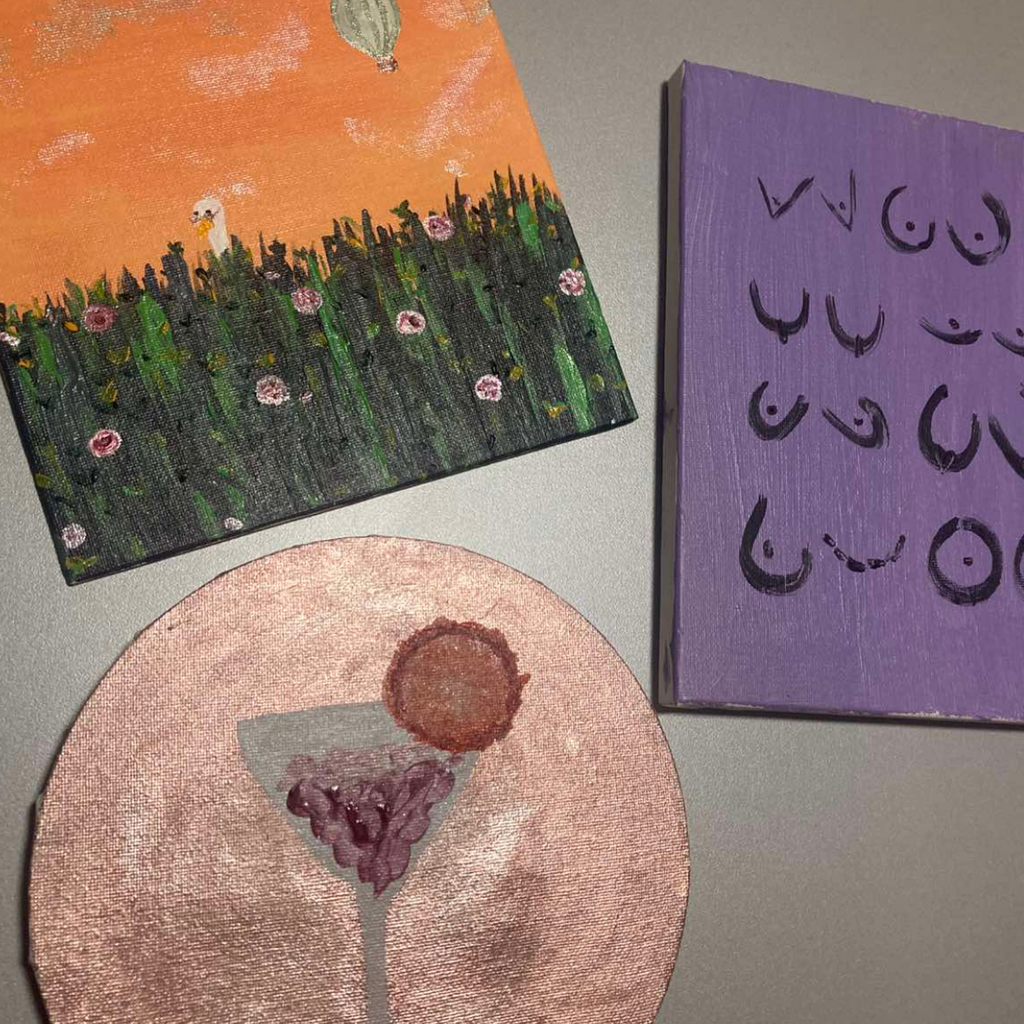
That sense of connection continued through the next two activities. In the Feminism & Renaissance workshop, participants traded words for colour, using painting to explore the emotions and reflections sparked by the first workshop. In the Feminism & Rock, Paper, Scissors workshop, they turned those emotions into words through collages and poetry, while reflecting on normalised forms of violence in the media and creating collaborative artworks together. One participant was blind, and although the workshop relied heavily on visual activities, she was able to take part fully through verbal descriptions of the visual materials, with other participants naturally stepping in to support her when needed. This approach allowed everyone to engage with the activities in their own way, reinforcing the project’s focus on creating a space where creativity could be shared by all.
A participant described the workshops as:
A beautifully designed safe haven where creativity and education effortlessly came together… We laughed, shared honest life experiences, and strengthened our collective female energy. Seeing how art can break the silence around violence against women completely changed my perspective.
Taking Art into the Community
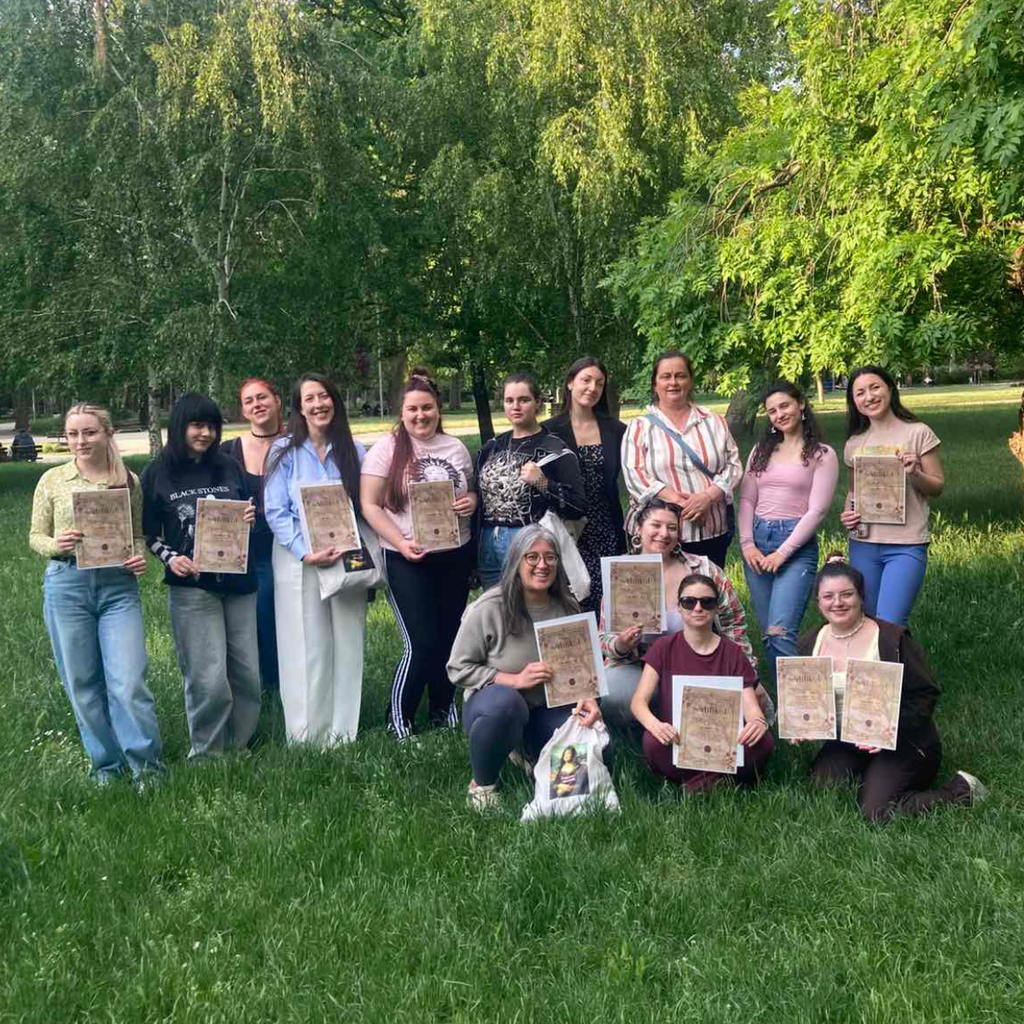
Everything created within the project found its place during the final picnic exhibition. The picnic turned what should have been an ordinary afternoon in the park into an extraordinary open-air gallery. Passersby stopped, curious about the artworks, often beginning with a simple ‘what is this?’.
Artists explained the stories and emotions behind their pieces, but visitors often saw something entirely different. At one point, a passerby even turned a painting upside down and said that, from that perspective, it made more sense to her. The moment became a powerful reminder of how perspective shapes what we see. Just like an idea behind an art piece, not all forms of violence are immediately visible, and experiences of fear, control, inequality or abuse can look very different depending on who is looking. For different visitors, the artworks brought to mind different personal experiences and emotions, and they raised questions. As the conversations continued, participants gradually moved beyond interpreting the artworks and began sharing stories of their own.
When Art Breaks the Silence
Looking back, perhaps the most valuable outcome of the project was never the art pieces, but the connections formed along the way.
Art cannot eliminate violence overnight, but it can challenge the conditions that allow violence to persist. It creates spaces where silence is replaced by dialogue, isolation by community, and fear by creativity.
In a world where violence often seeks to silence people, art offers something profoundly different – it gives them back their voice.
You just need a blank piece of paper to start.
References
- McCammon, R. (1991). Boy’s Life. Pocket Books.
- Kaimal, G., Ray, K., & Muniz, J. (2016). Reduction of Cortisol Levels and Participants’ Responses Following Art Making. Art Therapy: Journal of the American Art Therapy Association. https://doi.org/10.1080/07421656.2016.1166832
- Schouten, K. A., de Niet, G. J., Knipscheer, J. W., Kleber, R. J., & Hutschemaekers, G. J. M. (2015). The Effectiveness of Art Therapy in the Treatment of Traumatized Adults: A Systematic Review on Art Therapy and Trauma. Trauma, Violence, & Abuse, 16(2), 220–228. https://doi.org/10.1177/1524838014555032
- Corcoran, L., & Lane, A. (2018). Exploring the impact of Off the Beaten Path: Violence, Women, and Art. Women’s Studies International Forum. https://www.sciencedirect.com/science/article/abs/pii/S0277539517303400
- Encounters Film Festival. Granny’s Sexual Life. https://www.encounters.film/grannys-sexual-life-1
- The National Domestic Violence Hotline. Power and Control Wheel. https://www.thehotline.org/identify-abuse/power-and-control/
About the author: Teodora Milosavljević brings experience in PR and communications, alongside a strong commitment to human rights and gender equality. Her keen interest in the arts led her to co-initiate the With Art Violence Ends project with the Centre for Girls in Niš. Teodora is a 4th generation WAVE Youth Ambassador (2024–2026).
Featured images by With Art Violence Ends project
Disclaimer: The views and opinions expressed in this article are those of the author(s) and do not necessarily reflect the official policy or opinion/position of Women Against Violence Europe (WAVE).