WHO WE ARE
WAVE (Women Against Violence Europe) is a network of more than 190 women’s organisations in 46 European countries working to combat and prevent violence against women, their children and girls (VAWG). Our members are predominantly Women’s Specialist Services (WSS), such as women’s shelters, counselling centres and helplines; some are also national networks of these services. Academics and long-standing feminist activists are individual members too.
WAVE is the only European network that works solely on preventing and combating violence against women and girls.
Since 1994, WAVE unites women’s specialist services across Europe. We build bridges between organisations and strengthen their skills through training, working groups and peer exchange. We support them financially through regranting and our Emergency Fund, especially where war, natural disasters or hostile environments put them under immense pressure. And we stand with them through solidarity meetings and shared advocacy, giving them a strong collective voice.
Our vision: A world free from violence against women.
Our mission: Uniting Europe’s women’s specialist services to end violence against women.
How we reach our goals
Prevention
Primary prevention stops violence before it happens by tackling its root causes: unequal distribution of power and resources between women and men, discriminatory norms, stereotypes and harmful attitudes that enable and validate violence, and a lack of prevention skills in professionals and the general public. By promoting gender equality and safety across all areas of life, primary prevention is the most strategic and transformative approach to ending violence against women and girls. We build our members’ skills and share what works across borders.
Protection
A law only protects women if it is applied. We collaborate with and train legal professionals and other key stakeholders, push for proper implementation of existing laws, and work to improve women’s access to justice.
Support
Women and children who experience violence need specialist support that is built around their specific needs. Such services run by women’s organisations provide holistic support that is trauma-informed and gender sensitive, with the ultimate aim to empower the women and their children.
WAVE unites women’s organisations in 46 European countries through its feminist values, flexible funding and exchange of good practices. Members support one another in times of crisis and beyond, which makes the help available to women and their children stronger and sustainable.
Policy
We push and advocate for stronger laws and standards protecting women and children victims of violence at the European and international level. We aim for the highest feminist standard, not the minimum the law requires.
How we work
Network &
Capacity Building
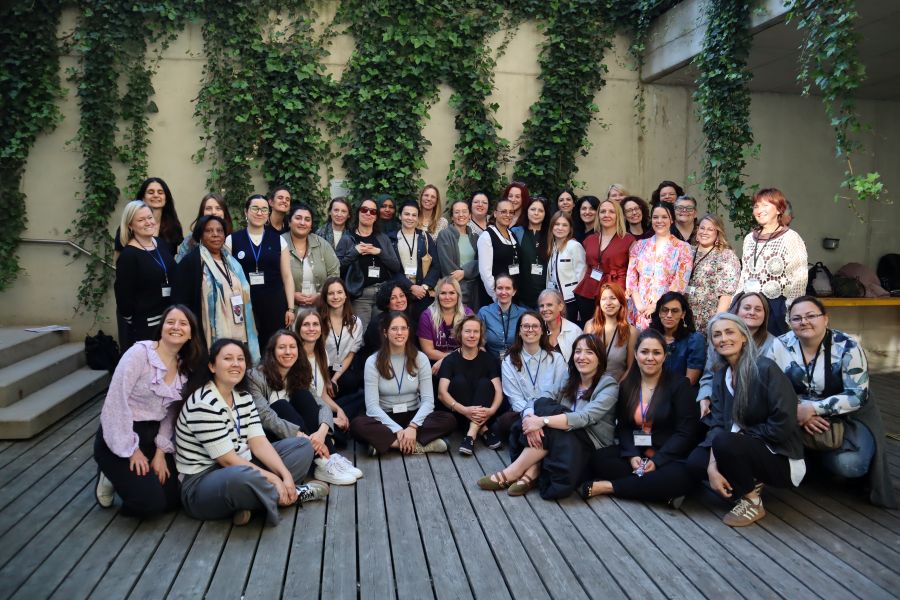
Through trainings, mutual learning exchanges, webinars, study visits, conferences and partnership projects, we are strengthening the capacities of our members so they can support women and children to live free from violence.
Advocacy & Communication
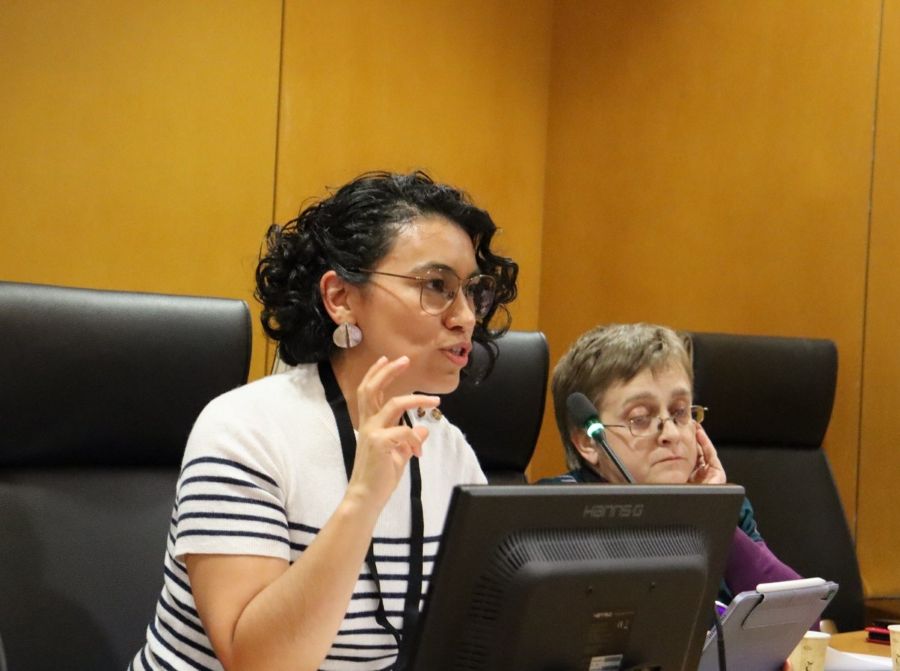
We advocate and campaign for better legislation and implementation of existing legislation to tackle violence against women and for sufficient funding for women’s specialist services.
Data Collection & Research
Through data collection and analysis about women’s specialist support services in 46 countries, we identify gaps and barriers in support services and the implementation of the Istanbul Convention.
Our Projects
In addition to the core work, WAVE partners regulary with members in European and international projects. Read more.
The Problem we are working on
Violence against women is structural: it is rooted in inequality, not in individual incidents. The Istanbul Convention, Europe’s key treaty on the issue, describes it as the product of historically unequal power relations between women and men, and as one of the social mechanisms that keep women in a subordinate position. Its Explanatory Report adds that gender-based violence is both a cause and a result of this inequality, embedded in the social and cultural structures, norms and values that govern society.
About 83,000 women and girls were intentionally killed worldwide in 2024, around 60% of them by a partner or family member. In Europe, 64% of the women killed by a partner or family member were killed by their intimate partner.
Violence against women does not only happen to individual women. It is kept in place by the conditions around them: the services they can reach, the money behind those services, and the politics and norms that shape both.
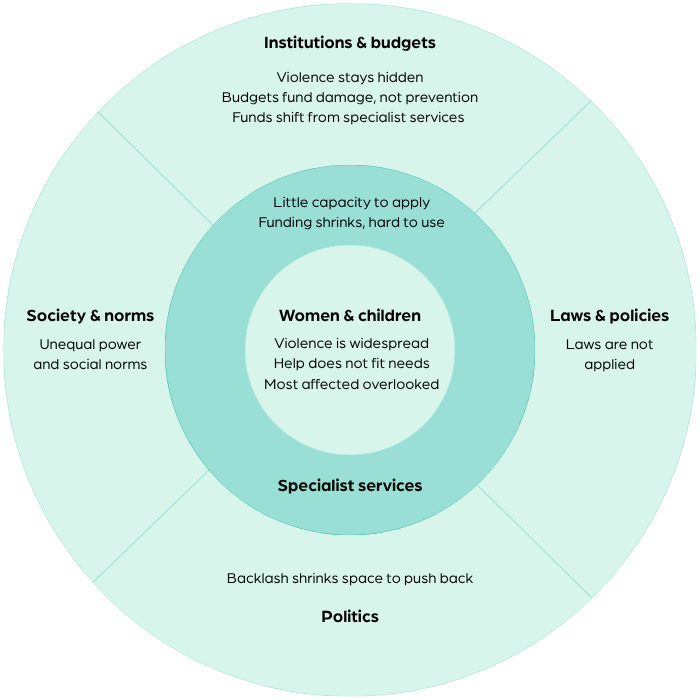
Violence is widespread. At least 1 in 3 women in the EU experiences physical or sexual violence. Children who witness it are victims too.
Help does not fit needs. Generic, gender-neutral services are built to serve everyone, so they are often not able to address the specific forms of violence that different women experience. This can make their trauma worse, and women are more likely to be revictimised during such processes or face violence again.
Most affected overlooked.
Women from marginalised groups, such as migrant women, women with a disabilities, Black and minoritised women, and trans women experience violence differently, facing different risks and barriers, and one standardised approach cannot respond to their needs in the same way. For example, women without papers can be locked out of services before they ask for help.
Little capacity to apply. Funders and governments often pay only for staff who work directly with survivors, not for a finance or fundraising person. Without one, small organisations have no time and often no know-how to apply for grants. Many do not apply at all and miss funding they would qualify for.
Funding shrinks, hard to use. Public funding for women’s organisations is shrinking. What remains is mostly short-term, project-based money for frontline work, not for core costs such as rent, finance staff or fundraising posts. Application rules are complex, and contracts often go to the cheapest bidder, not the most experienced
Violence stays hidden. Many cases are never reported, and data is incomplete. What is not counted is not seen, so the problem looks smaller than it is.
Laws are not applied. Laws and protection measures exist on paper, but they are not always applied. Emergency barring orders, which remove a perpetrator from the home, are rarely used or issued too late in many countries. Moreover, violence is overlooked when it comes to deciding on child custody and visitation rights. This leaves women and their children exposed to an escalation of violence.
Budgets fund damage, not prevention. Violence against women costs the EU around €289 billion a year, while services such as shelters make up just 0.4% of the cost of gender-based violence. Furthermore, governments spend far more on responding to violence than on preventing it.
Funds shift from specialist services. Governments increasingly move money towards generic, gender-neutral services that treat all survivors alike, and towards perpetrator programmes. In July 2025, the UK government announced £53 million for perpetrator programmes and nothing for specialist women’s services. There are no binding international standards for these programmes.
Unequal power and social norms. Violence is rooted in unequal power between women and men and in norms that excuse it. Backlash against women’s rights keeps these in place, so violence continues.
Backlash shrinks space to push back. Organised campaigns spread false claims about equality and about international agreements that protect women from violence, and target activists with smears and threats. Organisations have less freedom to speak out, and governments are pushed towards policies that hide the gendered nature of violence.
Our Impact
When women’s organisations close, women lose access to the important help they need. Additionally, violence against women is expensive. However, investment in women’s specialist services pays off. An Italian study estimates a social return of €7,15 for every euro invested in specialised services. The Women’s Resource Centre has calculated that the social value generated by women’s services is five to 11 times greater than the amount of money invested in them. Where violence is prevented and women get the right help early, fewer costs fall on police, courts, health and housing.
WAVE’s work answers the problems above at three levels: for women and children, for the services that support them, and for the laws, budgets and attitudes around them. It does so through a network of members. Since 2023, WAVE has given around €800,000 to members in regranting and emergency funding.
Achieving change through our network
Coming together as a network is our biggest strength and WAVE creates the spaces where specialist services meet: regional meetings, trainings, the WAVE Conference, every year brining together over 150 women’s humans rights defenders from more than 40 countries.
At a glance
198 member organisations, reaching over 1,800 organisations across Europe
€550,000 in 116 grants through regranting since 2023.
€258,697 to 42 members through the Emergency Fund since 2023
14 member organisations in 14 countries in WAVE-led projects since 2023, and at least 20 members collaborating on their own initiative since 2024
„The most valuable aspect [of WAVE spaces] was the opportunity to exchange experiences, practical ideas, and successful approaches with participants from different countries. I particularly appreciated learning how other organizations address similar challenges, develop advocacy strategies, and strengthen cooperation. This exchange inspired me with new ideas and highlighted the importance of solidarity, networking, and collective action.”
– WAVE member 2026
These encounters grow strong partnerships among our members. Since 2023, WAVE worked together with 14 member organisations from 14 countries in projects. Beyond that, at least 20 members have organised events and campaigns together, trained one another, hosted visits and joined forces on funding applications on their own initiative since 2024. Most recently in October 2026, our member Mor Çatı organised a conference in Istanbul where WAVE members from Denmark, France, Italy and Spain presented their work to organisations and municipal counselling centres across Türkiye.
Knowledge and expertise travel with our members. Four members from Armenia, Georgia, Bosnia and Herzegovina and Ukraine turned their experience of supporting women in war into a toolkit and training manual for other women’s organisations, each available in five languages. Each of the four member organisations later held trainings on ‘Preventing and Responding to Gender-Based Violence During War and in Post-War Settings’ which were highly successful reaching 149 professionals. WAVE reaches younger audiences through its Youth Ambassador program. Recently a Youth Ambassador organised a femicide panel at Central European University that drew over 80 participants, another Youth Ambassador was inspired to repeat it in their own country.
Support that reaches women survivors and their children
Members use small grants to reach women who are otherwise not reached. In 2024 and 2025, 34 microgrants of €300 were paid out during the 16 Days of Activism.
- Bosnia and Herzegovina. After a young woman was killed in Mostar, Association Novi Put brought its planned campaign forward. Two days later a march gathered hundreds of people, and a video for survivors was viewed almost 86,000 times. Requests for help rose, including from women outside the region, and volunteer psychotherapists answered them online.
- Estonia. A €300 grant funded an information day and a “Zero tolerance” campaign. According to the Pärnu Woman’s Support Center, contacts rose by 20% in November.
- Migrant women. In Malta, MWAM brought together women from ten countries for a storytelling and self-care evening. In Valencia, Por Ti Mujer reached migrant women with a campaign on migratory grief and mental health. Por Ti Mujer later presented at the conference in Istanbul organised by our member Mor Çatı.
- Cyprus. SPAVO trained 48 helpline and shelter professionals to recognise online abuse and help women keep evidence.
Keeping Women’s Specialist Services open, equipped and connected
Since 2023, WAVE has given around €550,000 to 116 member organisations through regranting, including microgrants. Many applications are for core costs and self-care, which most funders do not cover. In the Eurasia region, where sanctions, banking restrictions and foreign funding rules limit access to international funding, WAVE’s programme supports organisations that otherwise have few options.
When funding is cut or disaster strikes, the Emergency Fund has given €258,697 to 42 members since 2023. It has kept helplines running and paid staff, covered shelter costs that would otherwise have forced closure, made shelters safer, supported recovery after the 2024 floods in Valencia, and funded scholarships for girls from vulnerable families, including orphans of femicide.
Advocating for better laws, sufficient budgets and public debate
- Holding governments to account. In 2024 and 2025, we helped members in six countries write independent shadow reports for GREVIO, the Council of Europe body that monitors the Istanbul Convention, and produced our own shadow report on the EU implementation of the Istanbul Convention.
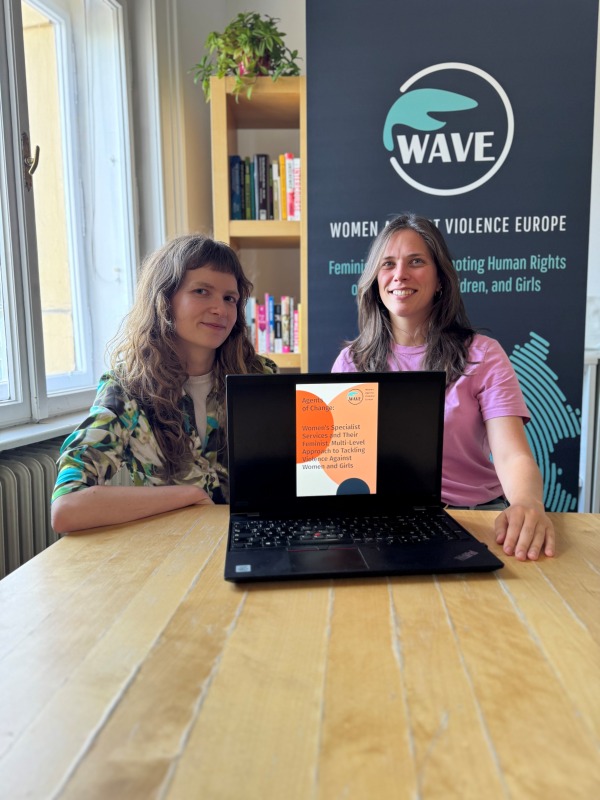
- Evidence. Our study Agents of Change (May 2026) shows what women’s specialist services achieve. The study reached over 150 professionals during the official launch in May 2026 and is constantly used in our advocacy efforts.
- Advocacy grants that open doors. With one grant of €1,100 each, five members in Albania, Croatia, Moldova and Türkiye reached over 85,000 people, mobilised 500 in public action and brought 30+ organisations and institutions into dialogue.
- Members bring evidence into public debate. In England, Women’s Aid used a WAVE microgrant for social media content on family court reform. It reached over 112,000 people on Instagram, and the petition grew to almost 5,000 signatures, with donations rising. GREVIO found in 2025 that in the UK domestic violence is either unrecognised by family courts or its impact is severely downplayed in child contact arrangements. In the UK, FiLiA Hague Mothers sent 85 copies of a booklet of mothers’ testimonies to MPs and Peers while a new clause in the Crime and Policing Bill was under discussion. In Serbia, Fenomena’s campaign on what the Istanbul Convention would look like in practice reached up to 20,329 people. coe
- A voice in Brussels. Advocacy trips bring staff, Board and members from across Europe, including non-EU countries, to consultations and policy discussions in person.
How we started
WAVE was established in 1994. The original idea to found the network can be traced back to a number of international events.
It all began in 1993
The widening of transnational cooperation began with the World Conference on Human Rights held in Vienna, Austria, in 1993. This conference established that acts of violence committed against women constituted human rights violations. These violations related to the violation of right to live a life free from violence and the right to freedom from fear and coercion. The conference’s final document, the Vienna Declaration, defines violence against women as a human rights violation and calls on states to take steps to prevent it. This success must be attributed to the active role which international women’s organisations played in the conference. One of the most important events of the conference agenda was the ‘Global Tribunal for Women’s Human Rights’. For a full day, women reported on their experiences of violence to government delegates and to international committee of experts. Following the conference, in December 1993, the United Nations General Assembly adopted the Declaration on the Elimination of Violence against Women. In the spring of 1994, the post of Special Rapporteur on Violence against Women was established at the Human Rights Commission in Geneva. Radhika Coomaraswamy from Sri Lanka was appointed to the post.
WAVE is established in 1994
In October 1994, the European and North American Preparatory meeting for the 4th United Nations Conference on Women (Beijing, 1995) took place in Vienna, Austria. European NGOs working in the field of violence against women took an active part in the conference, setting up a working group on ‘Violence and Human Rights Violations against Women’. It was during the meeting that a group of women working in women’s shelters and organisations working at combating violence put forward the idea of establishing a European network on violence against women, as a means of strengthening the feminist movement across Europe. This was believed to enable women’s organisations to collaborate and cooperate, to gain more influence and to more effectively fight for women’s rights and to promote the prevention and combating of violence against women on a European level.
WAVE and the 4th United Nations World Conference on Women in 1995
In the course of the 4th United Nations World Conference on Women, held in Beijing, PRC, in September 1995, progress was made in the formation of the European network. Its initiators ran a working group under the support of the NGO Forum, thus giving a wide public access to information on this undertaking.
The World Conference on Women marked a further step in combating violence against women. Measures against violence constituted one of the priorities in the Action Platform, the final document of the World Conference on Women. It contains a large number of recommendations and measures to prevent violence to be implemented by the member states. In the course of the World Conference on Women, the WAVE founding group held its constituent session. The group’s members included: Niamh Wilson of Irish Women’s Aid, Ebon Kram of the Swedish Women’s Shelters Network ROKS, Urszula Nowakowska of the Centrum Praw Kobiet (Women’s Rights Centre) in Warsaw, Marianne Cense of TransAct in the Netherlands, Lepa Mladjenovic of the SOS Hotline in Belgrade, and Rosa Logar of the Austrian Women’s Shelter Network (Verein der Autonomen Österreichischen Frauenhäuser).
First network working session in 1996
The first working session of the WAVE founding members took place in Utrecht, Netherlands, in October 1996. The meeting was financed by the participants themselves and/or their organisations. The agenda covered an initial definition of the network’s objectives and working principles, a discussion of goals and sources of funding, and the organisation of a European-level WAVE conference. At the beginning, the network was referred to as the Information Centre against Violence. The Eastern European delegates expressed their desire to form an Eastern European women’s projects against violence within the WAVE Network to serve the purpose of networking, because the background conditions and structures pertaining to their work differed markedly from those relating to the work of women’s organisations in Western Europe.
The international conference on ‘Women, Violence and Citizenship’
WAVE made an active contribution to the international conference on ‘Women, Violence and Citizenship’, held in Brighton, United Kingdom, in November 1996. During the conference, WAVE organised two working groups with an emphasis on introducing and enlarging the network, and additionally distributed its first folder and sought organisations to join the network.
Information meeting for WAVE members and international delegates
The first meeting took place in Vienna at the Intervention Centre against Domestic Violence on the 4th of December 1996.
First European ‘Daphne’ Project in 1997
The Vienna Information Centre against Violence assumed much of the responsibility for the network’s coordination and set about raising funds. Following the ‘4th World Conference on Women’ in Beijing in 1995, the European Commission began the ‘Daphne’ Initiative, supporting transnational projects aimed at preventing and combating violence against women and children. The WAVE Network successfully applied for funding and on the premises of the Information Office against Violence in Vienna, the WAVE coordination office was set up.
Since 1997, WAVE’s work has been continuously supported through funding by the European Commission.
First WAVE Conference 1998
The first WAVE conference took place in the year 1997 in Belgrade, Serbia. In 2003 the WAVE Conference becomes an annual event. Since then it has taken place in 17 European countries, from Lisbon to Bucharest, and twice online during Covid-19.
First Country Report in 2008
Since 2008 WAVE publishes its Country Reports. They are the main publication of the WAVE Network, and are published every two years. It is an essential tool for highlighting the situation of women’s specialist services across Europe from a feminist civil society perspective.
Youth Ambassador Program established 2018
WAVE sees the inclusion and engagement of youth as a crucial pillar of strengthening feminist movements across Europe. Since October 2018, the WAVE Youth Ambassadors initiative aims to provide a platform to youth activists in order to facilitate youth participation, youth campaigning and youth inclusion within the context of preventing and eliminating violence and discrimination against women and girls. Since the launch of our initiative, we have welcomed in total 44 WAVE Youth Ambassadors representing 27 EU and non-EU countries.
WAVE Emergency Fund established in 2023
WAVE’s Emergency Fund supports a network of over 190 organisations in 46 countries which provide safety, counselling shelter, and hope to survivors of violence. It allows us to respond quickly and flexibly in urgent situations. Through rapid support, we help our member organisations maintain essential services for women, their children, and girls when they are at risk of being reduced or interrupted. This can mean helping a shelter stay open, ensuring access to counselling and support, or stabilising services during times of crisis.
Regional meetings established in 2023
Celebrating over 30 years of WAVE
In 2024, WAVE celebrated its 30 year anniversary. Our important work continues, driven by the shared commitment to create a world in which women and girls live free from violence. We feel deeply privileged to carry this mission forward.