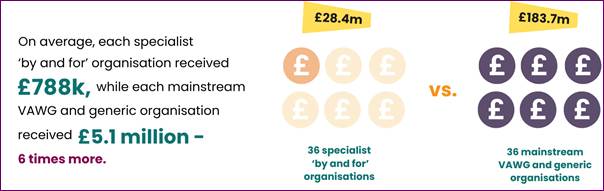
About: In more and more European countries, funding for women’s specialist services supporting women and girls affected by violence is at risk. But what does this mean for services supporting marginalised groups of women? Our UK member Imkaan puts the spotlight on services run by and for Black and minoritised women, showing how unequal funding puts them under pressure, as mainstream and generic organisations receive on average six times more funding than them. As ‘by and for’ services are rooted in their communities and bring specialist intersectional and survivor-centred expertise, this inequality limits Black and minoritised women’s access to the support they urgently need. However, Imkaan also shows how ‘by and for’ services continue to resist.
By Ritika Goyal, Rani Selvarajah, Sumanta Roy & Dr Ravi Thiara
For decades, Imkaan, the only national umbrella organisation for the Black and minoritised-led ‘by and for’ Violence against Women and Girls (VAWG) sector, has highlighted how Black and minoritised women and girls have been excluded from responses to VAWG.1 Imkaan has also shown that the Black and minoritised-led ‘by and for’ sector, rooted in the community that provides intersectional, holistic and trauma-informed support for them, is underfunded.
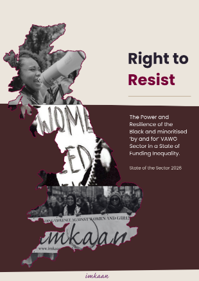
Imkaan’s 2026 report Right to Resist provides evidence of these longstanding structural inequalities, demonstrating not only that ‘by and for’ organisations are insufficiently funded, but that the way VAWG funding is designed and distributed systematically undervalues the specialist expertise, community infrastructure and unique models of support they provide.2
This report builds on Imkaan’s previous work, including State of the Sector (2015),3 Capital Losses (2016)4 and Survival to Sustainability (2018),5 which highlighted a precarious funding landscape faced by specialist ‘by and for’ organisations due to short-term funding, competitive tendering models and a preference for mainstream and generic VAWG organisations. It also builds on Imkaan’s evidence to the Home Affairs Select Committee’s 2025 inquiry, based on which the Committee concluded that VAWG cannot be addressed through generic, fragmented or short-term funding.6
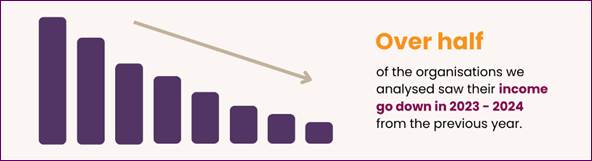
The report, drawing on annual reports, case studies and member insights, highlights the ongoing funding inequalities, sustainability challenges and structural barriers Imkaan members continue to face. These include inconsistent statutory funding, small and short-term grants, and declining income from charitable trusts and foundations.
A State of Funding Inequality
Our research revealed that:
- Financial instability, driven by short-term commissioning, the cost-of-living crisis, and increasing operational costs, remains a key barrier for Imkaan members in supporting Black and minoritised women.
- Insufficient funding for refuge, a severe lack of bed spaces and permanent housing, and the broader UK housing crisis prevent members from moving Black and minoritised women on from refuge to long-term safety and stability.
- Members are seeing an increasing number of Black and minoritised women with No Recourse to Public Funds (NRPF), a restriction that excludes migrant victim-survivors from accessing welfare support. This leaves ‘by and for’ organisations to fill critical gaps in provision, without adequate funding to meet this need.
- Members report worsening mental health outcomes among Black and minoritised victim-survivors, driven by the hostile environment, housing insecurity and broader socio-economic factors. This contributes to an increase in high-intensity, complex and high-risk casework and counselling referrals.
Demand for ‘by and for’ organisations is increasing. At the same time, the rise of the far right and growing anti-migrant and racist rhetoric and violence cause further harm and create additional barriers for women to disclose violence and seek support. Yet ‘by and for’ organisations have not received the funding required to meet these additional safeguarding needs and to provide trauma-informed VAWG support safely and securely.

A comparison between the income of specialist ‘by and for’ organisations and mainstream VAWG and generic organisations, showed clear structural inequalities. Despite the extensive reach of ‘by and for’ organisations at a grassroots level, funding remains concentrated within mainstream VAWG organisations, with ‘by and for’ organisations facing greater barriers to funding. Analysis using income bands from the National Council for Voluntary Organisations (NCVO) and the Charity Commission found that mainstream VAWG organisations dominate the higher income bands, while the majority of the ‘by and for’ sector sit in the lower income bands, although many of them have operated for around 40 years.
Additionally, we identified that the trend in commissioning practices that coerce smaller ‘by and for’ organisations into unequal partnerships with larger mainstream VAWG organisations in order to survive, continues long after Imkaan first identified it in Uncivil Partnerships? (2017).7 We examine how these commissioning trends entrench structural inequality, a process which we describe as ‘whitestreaming’. Within this landscape of funding inequality, Imkaan has in recent years had to fill critical funding gaps by acting as an intermediary to regrant funding to support the equitable redistribution of resources to ‘by and for’ organisations.
The Power and Resilience of ‘By and For’ Services
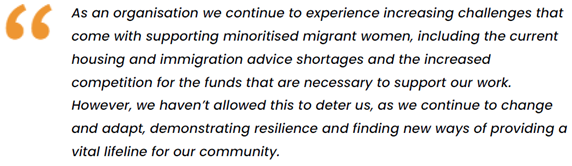
Despite multiple systemic and structural barriers, the ‘by and for’ sector has demonstrated remarkable resilience, not simply through sustaining services, but through resisting and challenging systemic inequalities – and continuing to assert the importance of specialist support for Black and minoritised victim-survivors of VAWG. As external pressures increase, these organisations may become an increasingly critical first point of contact for women who are reluctant or unable to access mainstream services. Funding models that fail to recognise this additional demand risk further reducing access to safety and support for some of the women facing the greatest barriers to help.
Therefore, a transformational approach to funding VAWG services is needed more than ever. To help achieve this, we have set out guiding ethical principles for more effective and equitable funding of the ‘by and for’ sector, building on principles set out in the Imkaan Accredited Quality Standards (2015).8 We have also included some examples of promising practices, including long-term commissioning, flexible core funding, ring-fenced funding pots designed and informed by ‘by and for’ expertise, and equitable ‘by and for’ led partnerships.
We hope that this report will be an important tool in advocating for a strengthened, more sustainable ‘by and for’ sector, both at a local level with commissioners and nationally as the Government looks to develop a cross-departmental commissioning statement as part of the VAWG Strategy.
References
- https://www.imkaan.org.uk/ ↩︎
- Goyal, R., Selvarajah, R., Roy, S. and Thiara, R. K. (2026) Right to Resist: The Power and Resilience of the Black and Minoritised ‘by and for’ VAWG Sector in a State of Funding Inequality. London: Imkaan. Available at: https://www.imkaan.org.uk/right-to-resist-state-of-the-sector-2026 ↩︎
- Imkaan (2015) The State of the Sector: Contextualising the current experiences of BME ending violence against women and girls organisations, Imkaan: London. Available at: https://static1.squarespace.com/static/5f7d9f4addc689717e6ea200/t/61e6a36ba920604b6cad594b/1642505069223/2015+_+Imkaan+_+State+of+the+Sector.pdf ↩︎
- Imkaan (2016) Capital Losses: The state of the specialist BME ending violence against women and girls sector in London, Imkaan: London. Available at: https://static1.squarespace.com/static/5f7d9f4addc689717e6ea200/t/621d317e5e79d16f780fa299/1646080384801/2016+%7C+Imkaan+%7C+Capital+Losses.pdf ↩︎
- Imkaan (2018) From Survival to Sustainability: Critical issues for the specialist black and ‘minority ethnic’ ending violence against women and girls sector in the UK, Imkaan: London. Available at: https://static1.squarespace.com/static/5f7d9f4addc689717e6ea200/t/621d22fd8548ef4509c01832/1770906180865/2018+%7C+Imkaan+%7C+From+Survival+to+Sustainability.pdf ↩︎
- Imkaan (2025) Imkaan Response Piece Home Affairs Select Committee backs calls for long-term, ring-fenced funding: Major step forward for ‘by and for’ Black and minoritised women’s VAWG services, London: Imkaan. Available at: https://www.imkaan.org.uk/home-affairs-committee-report-response-funding-vawg ↩︎
- Ascent and Imkaan (2017) Uncivil Partnerships? Reflections on collaborative working in the ending violence against women and girls sector: Good Practice Briefing. Available at: https://static1.squarespace.com/static/5f7d9f4addc689717e6ea200/t/60be3e4af3ffe3512ac611d9/1770906206625/2017+%7C+uncivil+partnerships%3F+reflections+on+collaborative+working+in+the+ending+violence+against+women+and+girls+sector+-+Good+Practice+Briefing.+London%3A+Ascent+%28London+VAWG+Consortium%29.pdf ↩︎
- Imkaan (2015) Accredited Quality Standards: Addressing violence against black and minority ethnic women and girls – Core Standards. Available at: https://static1.squarespace.com/static/5f7d9f4addc689717e6ea200/t/61e6a3ae7e14fd31f7d307ed/1642505134915/2015+_+Imkaan+_+Imkaan+Accredited+Quality+Standards.pdf ↩︎
About the authors: Ritika Goyal, Rani Selvarajah and Sumanta Roy are staff members at Imkaan, the UK’s only national umbrella organisation for Black and minoritised led ‘by and for’ sector ending violence against women and girls. Ritika is a human rights lawyer, and her recent research work includes examining commissioning practices of Integrated Care Boards. Rani has led key policy influencing, research projects and campaigns on mental health and housing justice. Sumanta specialises in social policy influencing on violence against women and girls, equalities and social justice, using participatory approaches to strengthen research, policy and practice. Dr Ravi Thiara is a Professor of Sociology at the University of Warwick and has conducted national and international research on violence against women and girls for over 30 years.
Cover image by Clay Banks on Unsplash
Featured images by Imkaan
Disclaimer: The views and opinions expressed in this article are those of the author(s) and do not necessarily reflect the official policy or opinion/position of Women Against Violence Europe (WAVE).