

1965, Sicily, Italy: a young woman named Franca Viola, abducted and raped for a week, had the courage to publicly refuse to marry her rapist, thus becoming the first Italian woman to defy a long-standing legal and cultural tradition that was harmful to women – the matrimonio riparatore (literally rehabilitating marriage, a sort of “marry-your-rapist” law) – that would have her marry her abuser to “restore” her honor. Instead, she and her family pressed charges against the rapist, Filippo Melodia, and won. Franca Viola thus became a symbol of cultural progress and emancipation of women in post-war Italy.

Inspiring Thursday: Margaret Hamilton
Margaret Hamilton is an American computer software programmer and systems engineer who, in the 1960s, served as Director of the Software Engineering Division of the MIT Instrumentation Laboratory. Renowned mathematician and computer science pioneer, she was the scientist who coined the term “software engineering” in the first place, to better describe her work. She was only in her early 30s when she led the team that developed the computer code for the command and lunar modules used on the Apollo missions to the Moon in the late 1960s and early 1970s.

Despite Dr Katie Bouman, there’s still a long way to go for women in STEM
In the past few days, you may probably have come across the picture of Dr Katie Bouman, the brilliant 29-year-old computer scientist who developed a crucial algorithm that helped produce the first ever image of a black hole. Even though the MIT graduate underlined that this scientific breakthrough was the result of successful teamwork, her thrilled expression in front of the computer with the fully-rendered black hole image has become one of the symbols of women’s achievements in STEM. In a Tweet shared by the MIT Labs’ profile, the photo of Bouman showing stacks of hard drives of the black hole image data was compared to the famous 1969 picture of Margaret Hamilton, the computer scientist who helped write the code that sent the first men to the moon.


Inspiring Thursday: Gisèle Halimi
Tunisian lawyer, anti-colonial activist, feminist, MP in the French National Assembly, always committed to gender equality and to defending women and the right to receive … read article

Inspiring Thursday: Judith Heumann
“Disability only becomes a tragedy for me when society fails to provide the things we need to lead our lives—job opportunities or barrier-free buildings, for … read article

Inspiring Thursday: Bertha Lutz
In the summer of 1945, during the San Francisco Conference, the United Nation Charter was signed, becoming the first international agreement to proclaim the equal rights of men and women as part of fundamental human rights. Out of 850 delegates who participated in the Convention, only four were women: one of them was the famous Brazilian zoologist, feminist activist and politician Bertha Lutz.

Swedish women’s organisations: We need a law against sex robots
‘Sex robots’ and ‘sex dolls’ reinforce and normalize views of women which objectify and normalize men’s violence against women. It is time for tightened legislation … read article

Inspiring Thursday: Fahmida Riaz
Born in 1946 in Meerut, India, Fahmida Riaz was a human rights activist, feminist, and one of Pakistan’s best known progressive writers and Urdu poets. Author of over a dozen books on poetry and fiction, she was often regarded as a controversial figure for her use of erotic and sensual themes and allusions in her writings.

The work of “Medica” Zenica with survivors of war rape and sexual violence in Bosnia and Herzegovina
About “Medica” Zenica(1)
Medica Zenica is the oldest specialized women’s non-governmental organization in Bosnia and Herzegovina (BiH), which, since April 1993 has been continuously providing comprehensive help, support and care to women and children survivors of war. Additionally, it also offers support to women and children suffering from post war violence, including survivors of war rape and other forms of war torture, sexual violence in general, survivors of domestic violence, as well as victims of trafficking in human beings. Medica Zenica is a leading organization addressing the issues of trauma and violence in BiH and during almost 23 years of work Medica Zenica has provided services to more than 450.000 survivors throughout the territory of BiH.
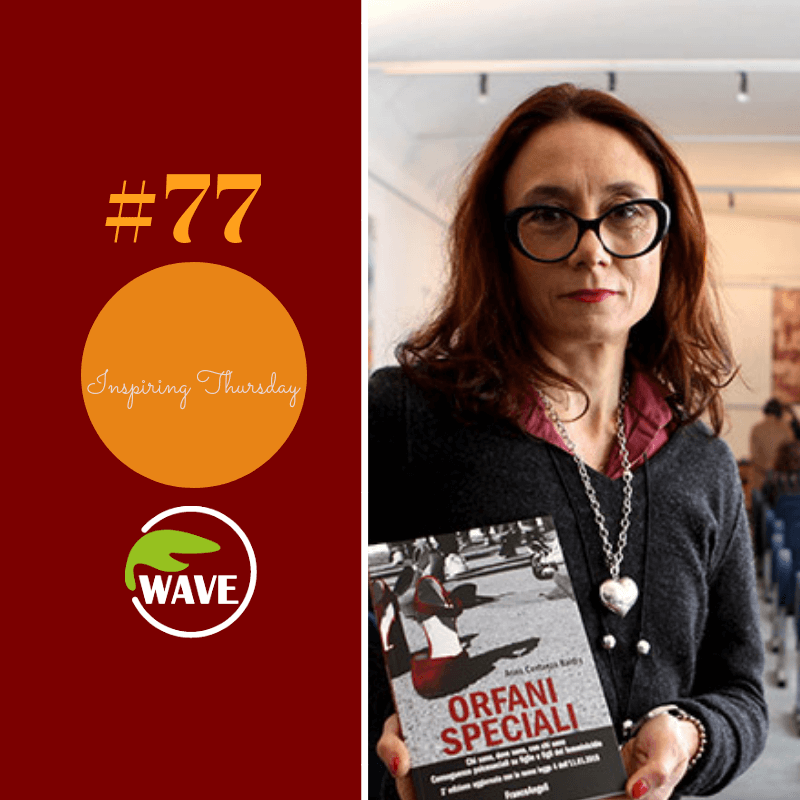
Inspiring Thursday: Anna Costanza Baldry
Anna Costanza Baldry was an Italian psychologist, criminologist and academic researcher who dedicated most of her life to women who have suffered violence and abuse, and to the protection of femicide victims’ children. Her work contributed to shedding light upon gender-based intimate partner violence, and to fostering the empowerment of the survivors. She prematurely passed away on March 9th at the age of 47, after a long illness.