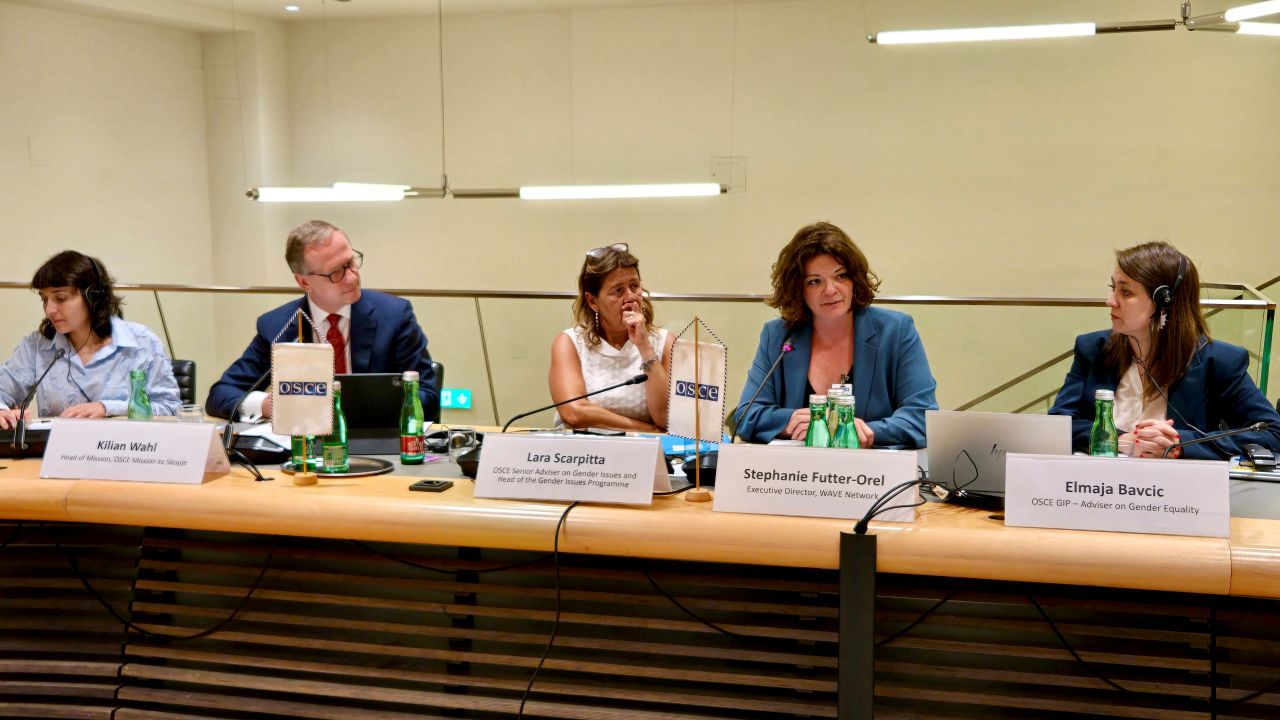
On 25 June 2026, WAVE Executive Director Stephanie Futter-Orel spoke at the OSCE expert meeting Mapping Trends and Best Practices in Combatting Femicide, joining policymakers and experts to discuss how participating States can strengthen efforts to prevent femicide across the OSCE region.
In her intervention, Stephanie Futter-Orel stressed that femicide is not an inevitable outcome of violence against women, but a foreseeable and preventable form of gender-based violence. She highlighted the urgent need to move beyond documenting cases towards implementing effective prevention measures and systemic reforms.
Drawing on findings from the WAVE Country Report 2025, she noted that at least 2,871 women were killed across 35 European countries in a single year, with 76% of victims killed by a current or former intimate partner. She also underlined that 11 countries still do not use the term “femicide”, making it more difficult to accurately record, analyse, and ultimately prevent these killings.
Stephanie identified three recurring structural challenges that continue to undermine prevention efforts across Europe:
- Visibility: Without recognising and recording femicide as such in law and official statistics, these killings remain hidden within broader homicide data.
- Protection: Weak inter-agency coordination, insufficient risk assessment, and inadequate enforcement can leave women at continued risk despite previous contact with authorities.
- Accountability: Only one in four European states systematically reviews femicide cases, limiting opportunities to identify systemic failures and improve prevention.
On behalf of WAVE, Stephanie called on OSCE participating States to take concrete action by:
- recognising femicide in legislation and official data collection;
- establishing femicide review panels in every state;
- sustainably funding femicide watches in partnership with civil society; and
- introducing mandatory training on coercive control for police, prosecutors, judges, and health professionals.
The discussion highlighted the importance of collaboration between governments, civil society organisations, and international institutions to strengthen prevention efforts and ensure that women at risk receive timely and effective protection.
WAVE thanks the OSCE for convening this important discussion, as well as Dr Lara Scarpitta and Anastasia Fusco for chairing the event, and fellow panellists Elmaja Bavcic, Rosanna Fabrizio, and Ambassador Killian Wahl for their valuable contributions.
Preventing femicide requires sustained political commitment, robust data collection, specialist services, and coordinated action. WAVE remains committed to working with partners across Europe to ensure that femicide is recognised, monitored, and, most importantly, prevented.