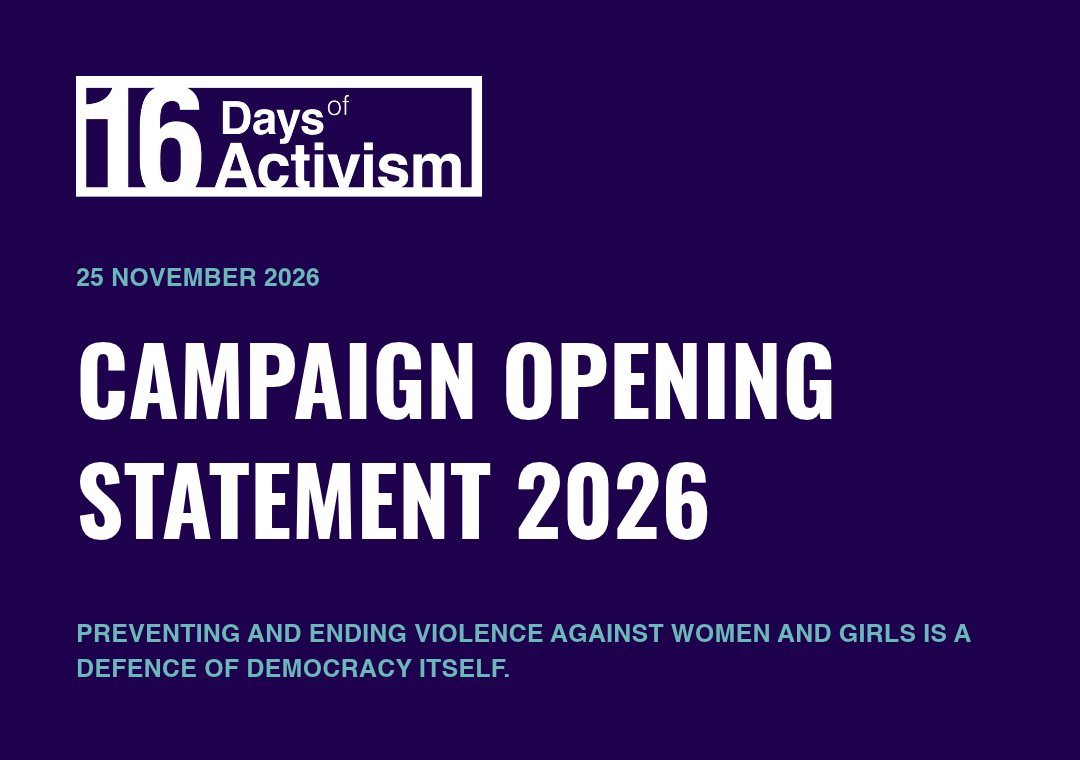
In a time of democratic backsliding and shrinking civic space, 25 November, the International Day for the Elimination of Violence against Women, is a stark reminder that democracy cannot exist without the right of women and girls to live free from violence. Violence denies women and girls equal participation in society and the full enjoyment of their human rights, which form the basis of democracy and civic life.
Across 46 countries, the WAVE Network represents over 1,800 women’s specialist services, from shelters, helplines, women’s support centres and specialised services for survivors of sexualised violence to primary prevention services. Built by feminist movements across Europe, women’s specialist services are part of civil society and of Europe’s democratic infrastructure, as their expertise and ethos embody democratic values and principles. With decades of experience in the gendered dynamics of violence, they protect women’s lives and defend women’s rights. In doing so, they defend civic space and carry the demands and struggles of women’s movements into public debate and policy, at a time when these spaces are under growing pressure.
Violence against women and girls is rooted in a patriarchal system that gender inequality upholds and that harmful gender stereotypes reproduce in institutions, public discourse and everyday life. Interlocking forms of oppression intensify the violence many women and girls experience and create structural barriers to their rights, protection and support. Policies that seek to protect and strengthen democracy must therefore place gender equality and an intersectional approach to the rights of women and girls at their centre.1
Across Europe, the pushback against women’s rights is intensifying and threatens democratic principles and the foundations they rest on. Hard-won gains, secured through decades of feminist struggle, are eroding faster than they were established. Anti-gender backlash and anti-feminist movements distort public debate with disinformation, promote patriarchal values and threaten women’s rights, undermining progress towards a life free from violence for all women and girls.2 For feminist civil society, this pushback also means shrinking space. Women’s rights organisations lose their place in policymaking and their funding, restrictions such as “foreign agent” laws stigmatise feminist civil society organisations and limit how they operate, and women’s human rights defenders face intimidation and attempts to silence them.3 At the same time, public funding shifts towards generic, gender-neutral services that obscure the gendered nature of violence and sideline the feminist and human rights-based approach of women’s specialist services. As a consequence, survivors lose access to the specialised support they urgently need, and Europe risks losing the expertise of women’s specialist services in preventing violence, both before it occurs and before it recurs.4
Technology now accelerates both this pushback and violence against women and girls itself. Through digital tools and platforms, as well as artificial intelligence, violence takes new forms faster than laws, institutions and tech companies can respond, from intimate images shared without consent and sexualised deepfakes to stalking through phones and connected devices. This technology-facilitated violence is violence against women and girls: it belongs to the same continuum as violence offline and grows from the same roots of gender inequality, unequal power and patriarchy.5 For this reason, it follows women and girls into their homes, schools, workplaces and communities. It also reaches those who speak up, as women’s human rights defenders, journalists and feminist activists face online abuse that aims to push them out of public debate.6Wherever violence against women and girls silences them, online or offline, democracy loses their voices.7
On this day, WAVE calls for the protection of civic space, which demands the full inclusion of feminist civil society to uphold democratic values and principles. Our demand goes further: every woman and girl must be free from violence and free to claim and live her human rights in full. That freedom depends on institutions, policies and society. Institutions must give women’s specialist services and feminist civil society a seat at the table, involve them in decision-making, listen to them and protect them, without sidelining or replacing them. They must also fund them sustainably, including in the next EU budget for 2028–2034. Policies must turn commitments into protection and draw on the expertise, voices and knowledge of feminist civil society. Society must dismantle the gender stereotypes and unequal power relations that keep this patriarchal system in place.8
There is no democracy without women’s rights, and no women’s rights without a feminist movement free to organise, speak and mobilise. Preventing and ending violence against women and girls is a defence of democracy itself.
WAVE Network
Empowering Women. Ending Violence.
See WAVE’s 16 Days of Activism 2026 calendar of activities.
For media: Download WAVE’s press release (PDF)
- Council of Europe. (2026). Implementation report of the Council of Europe Gender Equality Strategy 2024-2029 – Reporting period 2024-2025. https://rm.coe.int/prems-156426-gbr-2573-rapport-de-mise-en-oeuvre-de-la-strategie-text-a/48802e2e60 ↩︎
- Women Against Violence Europe. (2026). Agents of Change: Women’s Specialist Services and Their Feminist, Multi-Level Approach to Tackling Violence Against Women and Girls. https://wave-network.org/wp-content/uploads/2026/05/WAVE_Agents-of-Change.pdf ↩︎
- Council of Europe. (2026). 7th General Report on GREVIO’s activities. https://rm.coe.int/7th-general-report-on-grevio-s-activities/48802e059c ↩︎
- Women Against Violence Europe. (2026). Agents of Change: Women’s Specialist Services and Their Feminist, Multi-Level Approach to Tackling Violence Against Women and Girls. https://wave-network.org/wp-content/uploads/2026/05/WAVE_Agents-of-Change.pdf ↩︎
- Council of Europe. (2021). GREVIO General Recommendation No. 1 on the digital dimension of violence against women. https://rm.coe.int/grevio-rec-no-on-digital-violence-against-women/1680a49147 ↩︎
- Council of Europe. (2021). GREVIO General Recommendation No. 1 on the digital dimension of violence against women. https://rm.coe.int/grevio-rec-no-on-digital-violence-against-women/1680a49147 ↩︎
- Council of Europe. (2026). 7th General Report on GREVIO’s activities. https://rm.coe.int/prems-156426-gbr-2573-rapport-de-mise-en-oeuvre-de-la-strategie-text-a/48802e2e60 ↩︎
- see CEDAW General Recommendation No. 41 on dismantling gender stereotypes and the unequal power relations that sustain them. More here: https://www.ohchr.org/en/meeting-summaries/2026/10/committee-elimination-discrimination-against-women-holds-meeting-states ↩︎